
Prevention

PREVENTION BEFORE A CURE IS NEEDED
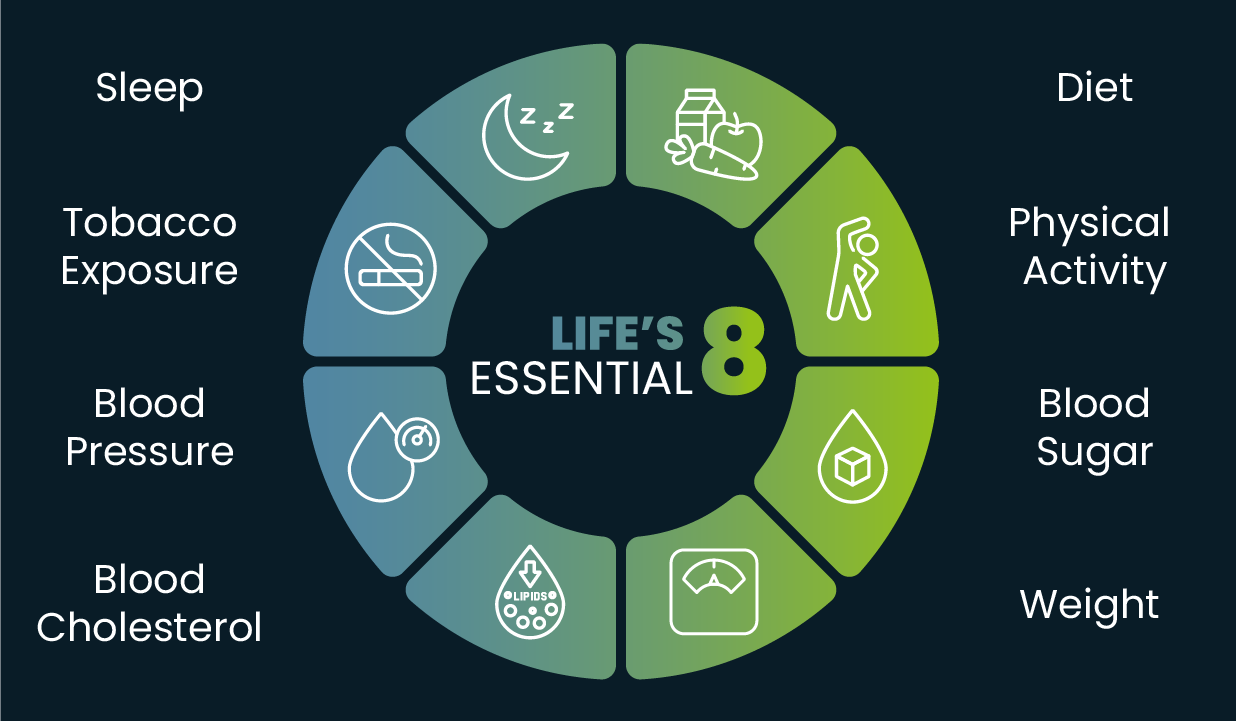
Evidence from large studies highlights the powerful impact of lifestyle behaviours. The American Heart Association’s “Life’s Essential 8” shows that a healthy diet, regular exercise, non-smoking, good sleep, and normal metabolic markers can add nearly a decade to life expectancy.
Source: American Heart Association
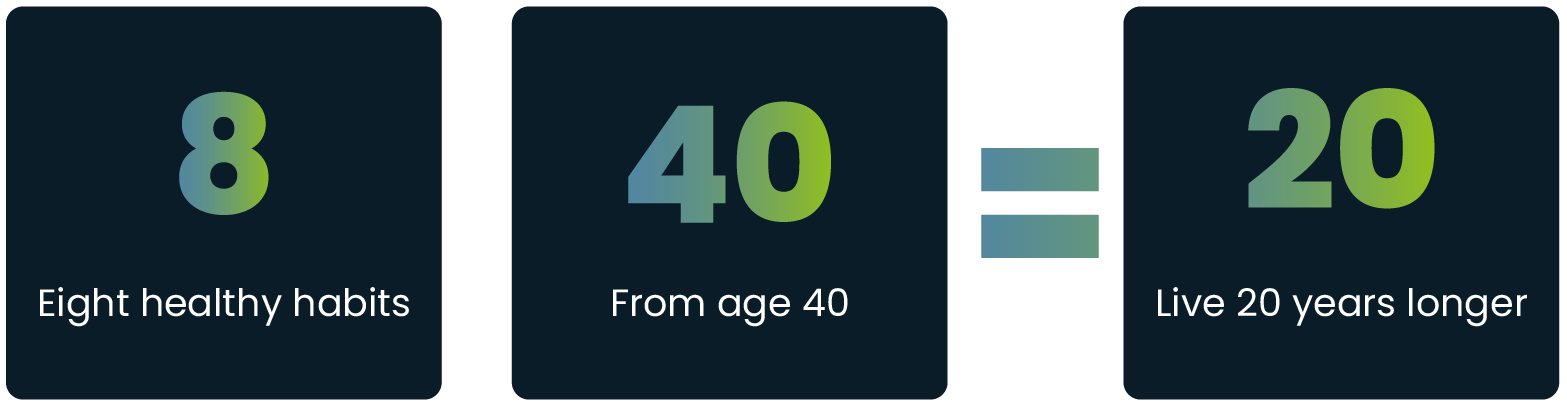
Similarly, the Veterans Study (2024), with over 700,000 participants, found men and women who adopted eight healthy habits from age 40 lived over 20 years longer than those who did not—gains still notable even when changes were made later in life.
Despite clear evidence, uptake remains low due to the intention-action gap: while most people want to age healthily, fewer follow through. Only half meet WHO physical activity targets, and dietary change remains limited. Behavioural strategies such as nudges, which simplify and default healthier choices, may be more effective than education alone.
For the first time according to 2025 WHO and UNICEF research, there are now more children globally living with obesity than those who are underweight, with around 188 million youths aged 5 to 19 classified as obese—almost one in every ten children worldwide. This alarming trend reflects a dramatic rise in childhood obesity rates, driven primarily by the increasing prevalence of ultra-processed, calorie-dense foods replacing traditional diets. While some regions like sub-Saharan Africa and South Asia still report higher rates of underweight children, the global shift signals an urgent need for comprehensive strategies to tackle childhood obesity at scale.
THE RISING COST OF OBESITY
1.1 THE ROLE OF PREVENTION
Research indicates that 70-80% of chronic diseases can be attributed to lifestyle factors, which are modifiable, while genetic factors account for about 20-30% (Crespo et al., 2011). This underscores the pivotal role of preventive measures in enhancing healthspan and longevity. A significant opportunity exists in promoting healthier lifestyles to reduce the incidence of chronic illnesses such as heart disease, diabetes, and obesity, thus shortening morbidity – the time spent in poor health at the end of life, and lengthening lifespans.
1.2 LIFESTYLE BEHAVIOURS, HEALTHSPAN AND LIFESPAN
The influence of simple lifestyle habits on both healthspan and lifespan has been powerfully demonstrated in recent research.
The American Heart Association’s “Life’s Essential 8” study (Luo et al., 2022) showed that achieving eight health metrics at age 50 could add up to nine years to life expectancy, in addition to reducing the risk of chronic disease. These metrics include a balanced diet, regular physical activity, avoiding smoking, adequate sleep, a healthy BMI, and maintaining normal blood lipids, blood glucose and blood pressure.
Even more convincing findings come from over 700,000 participants in the Million Veterans Study, which demonstrates the strong impact of lifestyle habits from the age of 40 onwards (Nguyen et al., 2024). Men adhering to all eight lifestyle habits gained 24 years in life expectancy compared to those who followed none (on average living to 87 years vs 63 years), while women gained 21 years (on average living to 88 years vs 67 years). The lifestyle habits included abstaining from smoking, engaging in regular exercise, consuming alcohol only in moderation, prioritising good sleep, following a healthy diet, managing stress, building strong relationships, and avoiding opioid disorders. Notably, even when healthy lifestyle habits were adopted after 50, males gained an additional 21 years, and females 19 years; and at age 60, an additional 17 years and 18 years, respectively.
Male : Estimated prolonged life expectancy at 40 compared to none low-risk lifestyle factor
Female : Estimated prolonged life expectancy at 40 compared to none low-risk lifestyle factor
Male : Estimated prolonged life expectancy at different ages by applying low-risk lifestyles
Female : Estimated prolonged life expectancy at different ages by applying low-risk lifestyles
1.3 THE INTENTION-ACTION GAP
Despite the overwhelming evidence for the role of lifestyle habits in healthy ageing, efforts to promote such changes have produced limited results due to a lack of engagement. While the majority of people state they want to experience old age in a healthy state and live longer (Maier et al., 2025), actual engagement in lifestyle changes remains limited – this is known as the intention-action gap. For instance, only 50% of the population meets the WHO’s recommended physical activity targets (World Health Organisation., 2024) and only 10% of the UK population omit meat from their diets (Healey, 2025).
This disconnect emphasizes the importance of targeted behaviour change strategies that simplify healthy choices in order to bridge the action-intention gap. Nudging—making healthy behaviour the easier or default option—has been shown to be a more effective strategy for promoting lifestyle changes than traditional education alone. Even small adjustments in how choices are presented can lead to significant increases in physical activity and greater engagement with health-promoting resources
In order to improve lifestyle behaviour change, a greater understanding of the barriers and facilitators of healthy lifestyles, beyond education, awareness and availability is needed. Recent research suggests that upstream factors such as personality traits and risk appetite may predict and determine engagement with certain lifestyle behaviours, an area that warrants further investigation.
1.4 INNOVATION IN PREVENTION
In recent years, a wave of new interventions has emerged, promising to extend both healthspan and lifespan beyond what can be achieved through traditional lifestyle habits alone. Whilst the science behind these interventions is not always as robust as for established lifestyle changes, they hold promise to be used as adjunct therapies to optimise healthy ageing.
Among the most prominent are pharmacological agents such as GLP1s (and newer related agents), metformin and rapamycin, which have shown potential to delay the onset of age-related diseases in animal and some human studies.
Supplementation with non-pharmacological agents has also gained much interest. Other experimental approaches include senolytics (drugs that remove senescent cells), intermittent fasting protocols, and various “rejuvenation” therapies, such as young plasma infusions and gene editing.
While these strategies are exciting from a scientific perspective, most are still in early-stage trials or have only demonstrated efficacy only in animal models. Their potential to add years to human life is, at present, largely experimental and any projected increases are dwarfed by the robust results seen with habits like regular exercise, not smoking and maintaining a healthy diet.
In summary, while lifestyle behaviours account for the majority of the expected gains in health and lifespan, the emergence of adjunct interventions, whether by facilitating healthier lifestyles or targeting ageing processes at the cellular level, could dramatically fast-track improvements in this area.
1.5 ACTORS AND STAKEHOLDERS
The health sector is a key driver of prevention of disease but its influence is limited by lack of access to people’s real-life environments. However, recent initiatives such as NHS social prescribing, whereby healthcare professionals can recommend and subsidise community-based activities such as exercise classes or health support groups tailored to individual patient’s interests and needs, can be leveraged to foster healthier behaviours. Brief interventions for tobacco cessation highlight the importance of training healthcare providers to deliver succinct, impactful advice (Chirila et al., 2024).
Moreover, the responsibility for promoting public health extends beyond policymakers to a wide range of stakeholders across sectors. A collaborative approach involving policymakers, private sector entities, and non-profit organizations is increasingly recognised as essential. Initiatives like the World Health Organization’s (WHO) Global Compact on Health encourage diverse industries to assess their health impacts and implement changes that benefit communities (WHO, 2020). Such collaborations can include investing in health-promoting urban infrastructure or funding social impact projects designed to increase physical activity among underserved populations.
1.6 SHIFTING FROM PATIENT TO CONSUMER-FOCUSED OFFERINGS
The rise of digital health tools marks a shift in prevention strategies from traditional healthcare settings towards a more consumer-oriented model. This transition emphasizes the importance of tailoring health offerings to consumers rather than patients. Crucially, a wholesale shift in mindset is required away from treating disease to prioritising prevention, for example:
- Mechanisms of communication must adapt to better address the needs of the public.
- The health system financing model should incentivize health and prevention over diseased populations.
- Digital health companies should be able to more readily collaborate and coordinate with the health sector.
- Reference ranges for biomarkers should be researched and standardised for optimal health levels rather than disease states.
- Enabling data from digital health tools and the IoT, if sufficiently valid, to be used in conjunction with data ascertained from healthcare services.
More research is necessary to establish health resources that cater effectively to consumer wellness rather than merely treating illnesses.
1.7 FINANCING PREVENTION
Investing in preventive measures not only benefits health outcomes but also offers substantial returns on investment. Studies show that for every $1 spent on prevention, there is a return of approximately $2 to $6, illustrating the financial viability of preventive health programs (Linzer et al., 2020). Such models demonstrate the effectiveness of investing in public health initiatives that emphasize prevention.
The Milken Institute as part of its “Project Prevent” initiative, convened leaders to identify innovative funding mechanisms for disease prevention. Some of the key ideas that would foster funding from non-health sectors included the use of blended finance models, business relief and tax incentivisation, as well as an idea for a new Social Impact Bond to spur further investment (Radford et al., 2025).
By adopting a multifaceted approach that includes preventive strategies, understanding public sentiment, engaging various sectors, shifting focus to consumer needs, and financing preventive measures effectively, we can foster an environment that promotes longevity and enhances healthspan across populations.
The core pillars for prevention for improving healthspan and lifespan, namely nutrition, physical activity, emotional wellbeing and sleep, are examined in more detail over the following chapters followed by a chapter on emerging insights and interventions that could further optimise health and lifespan going forward.


