
5.2.1 Cognitive health
Cognitive and brain health is a rapidly expanding field as it is a critical determinant of independence, quality of life, and overall survival.
Women have a higher overall lifetime prevalence of dementia, largely because they live longer, but they also have a higher risk of Alzheimer’s disease than men of the same age (Livingston et al., 2020; ADI, 2024).
The total number of people living with dementia is predicted to triple globally by 2050, rising from approximately 57 million in 2019 to 153 million, with the steepest increases occurring in LMICs (Livingston et al., 2020). However, in high-income countries the age-specific incidence and prevalence of dementia may be starting to fall or stabilize, attributed in part to better control of modifiable risk factors like hypertension, and higher educational attainment (Livingston et al., 2020). A modest reduction in the prevalence of the modifiable risk factors—even a 10% reduction per decade—could delay or prevent millions of dementia cases worldwide (Livingston et al., 2020).
Impact on Healthy Ageing
Cognitive function—including memory, attention, executive function, and processing speed—is essential for conducting daily activities, making informed decisions about one’s health and lifestyle, and maintaining social engagement. Decline in cognitive health, often leading to conditions like mild cognitive impairment or dementia, severely diminishes an individual’s capacity for independent living, dramatically increasing the burden of disease, disability, and need for care, thus shortening a person’s active healthspan.
Furthermore, cognitive decline is intertwined with poor physical health; it often precedes or coexists with mobility issues, frailty, and chronic diseases, establishing a bidirectional link where poor mental health also negatively impacts physical well-being and longevity.
Studies consistently show that cognitive impairment is an independent predictor of increased all-cause mortality. For adults aged 60 years, those with low global cognition (in the lowest quartile of test scores) have an approximately 46% increased risk of death, after accounting for other health factors like age and sex (Wang et al., 2024). Maintaining cognitive function significantly contributes to a longer, healthier life by providing powerful protection against the risk of death from numerous causes.
The burden of severely diminished cognitive health is starkly quantified by its economic impact and the profound effect on caregivers. Dementia, the most severe form of cognitive decline, is ranked as the seventh leading cause of death globally and is one of the major causes of disability and dependency among older people (WHO, 2025). The global economic cost of dementia was estimated to be US$ 1.3 trillion in 2019, with approximately half of this cost (US$650 billion) attributed to the care provided by informal family members and friends (WHO, 2025).
This immense figure demonstrates that the maintenance of cognitive health is not only a personal health imperative but also a significant factor in public health and economic stability, directly quantifying the decades of healthy function and independence preserved by a long healthspan.
Link Between Cognitive Health and Other Health Outcomes
Cognitive decline is closely and detrimentally linked to other major health outcomes, primarily by accelerating a decline in physical function and drastically increasing morbidity and mortality risks. This manifests in significantly compromised mobility due to impaired cognitive-motor control. The decline in physical ability substantially raises the danger of injury, with seniors experiencing dementia having more than twice the rate of hospital admissions for fall-related injuries compared to their cognitively intact peers (Canadian Institute for Health Information, 2017). Cognitive impairment is strongly associated with an increased prevalence and poorer prognosis of CVD, where adults with heart disease have a 27% higher risk of developing dementia (American Heart Association, 2025).
Financially, this has a profound impact on healthcare systems, with individuals who have mild cognitive impairment accruing 7.6% higher inpatient costs over a decade compared to matched individuals with normal cognitive functioning (Trevisan et al, 2021). This underscores that cognitive decline is not an isolated event but a critical component of a broader, interwoven process of physical and health deterioration.
Strategy
Dementia is highly preventable – approximately 45% of global dementia cases could be prevented or delayed by addressing a set of 14 modifiable risk factors according to the Lancet Commission on dementia (ADI, 2024). The figure below illustrates the life course approach to the aetiology of cognitive decline, as well as the magnitude of the estimated impact of removing risk factors on the prevalence of dementia (Livingston et al., 2020; ADI, 2024).
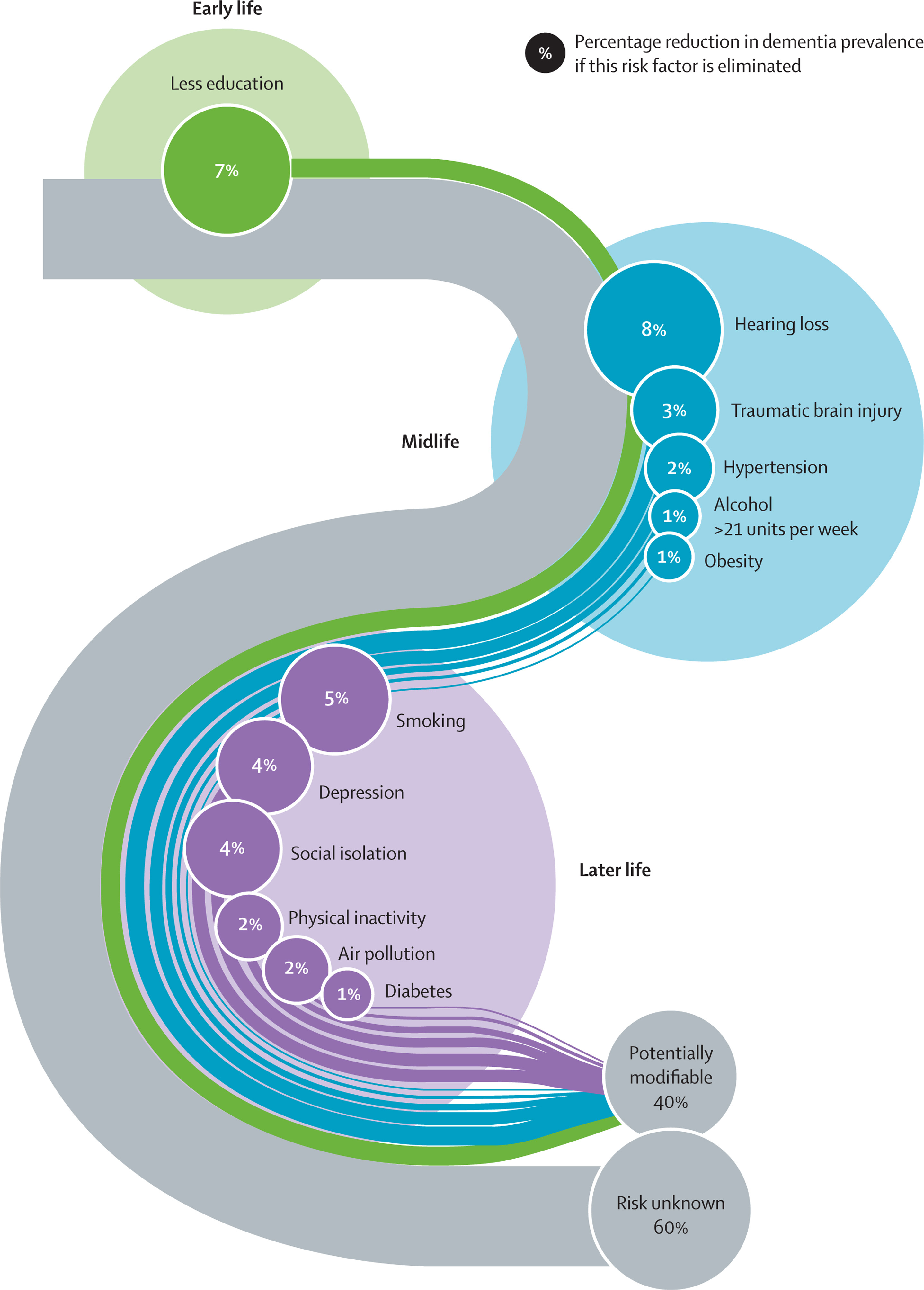
Figure. Impact of Risk Factor Elimination on Prevalence of Dementia Source: Livingston et al., 2020.
While this model addresses the theoretical reduction upon eliminating a risk factor, some intervention trials have quantified a direct risk reduction from specific actions:
Physical Activity: Engaging in even small amounts of exercise is highly effective. Compared to zero minutes per week, engaging in as little as 1 to 35 minutes per week of moderate-to-vigorous physical activity was associated with a 41% reduced risk of dementia over a four-year period. This reduction increases to 69% for those meeting or exceeding the recommended guidelines of 140+ minutes per week (Wanigatunga et al., 2025).
Multidomain Intervention: Combining interventions has a powerful, measurable impact. The Finnish Geriatric Intervention Study to Prevent Cognitive Impairment and Disability (FINGER trial) showed that a two-year, multidomain intervention (diet, exercise, cognitive training, and vascular risk management) resulted in a 25% improvement in global cognition scores compared to the control group in older adults at risk of dementia (Ngandu et al., 2015).
Vaccination: Recent large-scale studies have suggested an immunomodulatory effect from certain vaccines. The Shingles vaccine (Shingrix) was associated with a 17% lower risk of dementia over six years compared to an older vaccine (ADI, 2025).
Considerations by Age Group
The key policy considerations, largely informed by the recommendations of the Lancet Commission (Livingston, 2024), focus on a comprehensive, life-course approach:
Early Life (Childhood to Young Adulthood)
Policy should aim to build cognitive reserve by maximizing educational attainment.
- Universal, High-Quality Education:
Mandating and ensuring access to quality primary and secondary education for all children (Livingston et al., 2020). Low educational attainment is one of the single largest preventable risk factors. Increased education builds a robust cognitive reserve, allowing the brain to better tolerate pathology later in life.
Mid-Life
This stage is critical for controlling vascular risk factors and protecting against injury.
- Vascular Health Management:
Implementing population-level policies (e.g., fiscal incentives, legislation) to reduce dietary salt, sugar, and unhealthy fats to combat hypertension and obesity (National Institute for Health and Care Research, 2025).
Strengthening and expanding primary care screening and treatment programs to ensure hypertension is aggressively managed to a systolic blood pressure ≤130 mmHg from age 40 (Livingston et al., 2020).
ublic health campaigns and regulatory measures targeting diabetes and high LDL cholesterol management.
- Hearing and Head Injury Protection:
Subsidizing or making hearing aids universally accessible and affordable for those with hearing loss, as this is the largest single modifiable risk factor (Livingston et al., 2020).
Implementing legislative measures to prevent Traumatic Brain Injury (TBI), such as mandatory helmet use for certain activities and stricter safety standards in high-risk occupations and transport (Livingston et al., 2020).
- Substance Control:
Introducing price controls and taxation on alcohol and tobacco, coupled with strict limits on advertising, to reduce smoking and excessive alcohol consumption (Livingston et al., 2020).
Late Life
Focus shifts to maintaining physical, social, and mental engagement, and addressing sensory and environmental factors.
- Creating Active and Social Environments:
Investing in age-friendly urban planning (e.g., walkable communities, accessible public transport) to promote physical activity and reduce social isolation (Livingston et al., 2020).
Funding community-based social programs and volunteering opportunities to increase social contact and cognitive stimulation for older adults.
- Environmental Protection:
Urgent air quality improvements through legislation (e.g., low-emission zones, industrial regulation) to reduce exposure to air pollution (Livingston et al., 2020).
- Mental and Sensory Health:
Integrating mental health screening and accessible treatment for depression into primary care for older adults.
Ensuring screening and affordable treatment for uncorrected vision loss (e.g., cataracts) as part of routine older adult healthcare (ADI, 2024).
Policy
Dementia prevention at the population level requires a shift from focusing solely on individual behavioural change to implementing structural, policy, and environmental interventions that address the root causes of modifiable risk factors across the entire lifespan. Since up to 45% of dementia cases may be preventable (ADI, 2024), policy efforts must integrate health promotion into non-health sectors like education, transportation, and urban planning.
Key Policy Considerations
- Equity Focus: Policy must prioritize groups disproportionately affected by risk factors, such as those in low- and middle-income countries or socioeconomically disadvantaged populations, to reduce health inequalities (Livingston et al., 2020).
- Multidomain Intervention: Public health strategies should promote a combined intervention approach that addresses multiple risk factors simultaneously, as the evidence shows this is more effective than targeting a single factor (Ngandu et al., 2015).
- Cost-Effectiveness: Population-level policies, such as reducing salt in food or regulating tobacco, are highly cost-effective and can lead to significant savings in future healthcare and social care costs by compressing the time a person lives with ill health (National Institute for Health and Care Research, 2025).
Private Sector
Innovation and the private sector are vital for scaling up dementia prevention, particularly through digital health and technology that targets modifiable risk factors like physical inactivity, hearing loss, and social isolation. Stakeholders across all sectors must collaborate to ensure these solutions are accessible and integrated into public health strategies.
Innovations and Private Sector Solutions
Private companies and innovators are primarily focused on developing accessible, personalized, and engaging tools to help individuals manage their own risk factors.
1. Digital Health and Wearable Technology
- Risk Factor Management: Digital Health Interventions are increasingly used to track, monitor, and guide healthy behaviors.
Hypertension & Diabetes: Apps and wearable devices monitor vital signs (blood pressure, glucose) and send personalized reminders for medication adherence and lifestyle adjustments.
Physical Inactivity: Fitness trackers and apps encourage physical activity by setting goals and providing exercise guidance (often tied to rewards or social challenges).
Sleep & Behavior Tracking: Smart home devices and wearables monitor sleep patterns and subtle behavioral changes, which can provide early indicators of functional or cognitive decline to caregivers and clinicians.
- Cognitive and Social Engagement:
Cognitive Training Apps: Commercial “brain games” and platforms offer exercises to stimulate attention, memory, and problem-solving skills, supporting the maintenance of cognitive reserve.
Social Connectivity: Digital platforms and apps help older adults maintain social connections, organize community activities, and reduce social isolation, a key risk factor.
2. Specialized Technology for Sensory Loss
- Design for Accessibility: Ensure products are financially and technically accessible to older adults, people with low digital literacy, and those with physical disabilities.
- Hearing Health Solutions: Companies are developing more affordable, high-quality, and user-friendly hearing aids and novel hearing health apps. For example, some apps are designed to improve listening skills and reduce noise exposure.
- Vision Correction: Innovations in quick, accessible, and affordable screening and treatment for age-related vision problems like cataracts and diabetic retinopathy help address these newly recognized risk factors.
3. Integrated Care Delivery Models
- AI and Data Analytics: Private companies use AI to analyze large data sets (digital phenotyping) from wearables, medical records, and imaging to identify high-risk individuals earlier and create more personalized prevention plans.
- Decentralized Trials: Technology is used to decentralize clinical trials, making participation more accessible and allowing for the continuous, real-world monitoring of participants’ cognitive function and lifestyle changes.
- 5.1 Introduction
- 5.2.1 Cognitive health
- 5.2.2 Oral health
- 5.2.3 Microbiome
- 5.2.4 Cellular ageing
- 5.3.2 Senolytic drugs
- 5.3.3 Peptide based therapies